The new sensation that’s sweeping the nation

November 23rd, 2009

One of my favorite subgenres of teen pop/teen movies of the '50s and '60s are the feeble attempts to force kids into adopting new crazes. In trying to mimic the success of "The Twist" and "The Loco-Motion," most of the pop songs had accompanying dances. The songs are always kind of pushy, because instead of simply introducing the new dance, they instead declare that the dances are already the next big thing that all the kids are doing. It's interesting also how much the songs must have depended on television appearances to ensure their popularity (though I guess I don't actually know what the "Loco-Motion" dance is). The teen films tended to exploit familiar fads (surfing, dragracing etc.), while also branching out to new ones. The Frankie & Annette Beach Party series was really good at this: Beach Blanket Bingo was all about skydiving, Muscle Beach Party had bodybuilding, and Pajama Party was about, uhh, pajamas.

There are countless examples of these, but I've been recently introduced to a couple really bizarre ones that I like a lot. One is the 1957 film Bop Girl Goes Calypso, which is about how a scientist with some fancy machine is "proving" that rock 'n' roll is on the way out, predicting that calypso will be the big new craze! There were a few films that came out at this time all with the same hypothesis, including Calypso Heat Wave which features Maya Angelou(!)

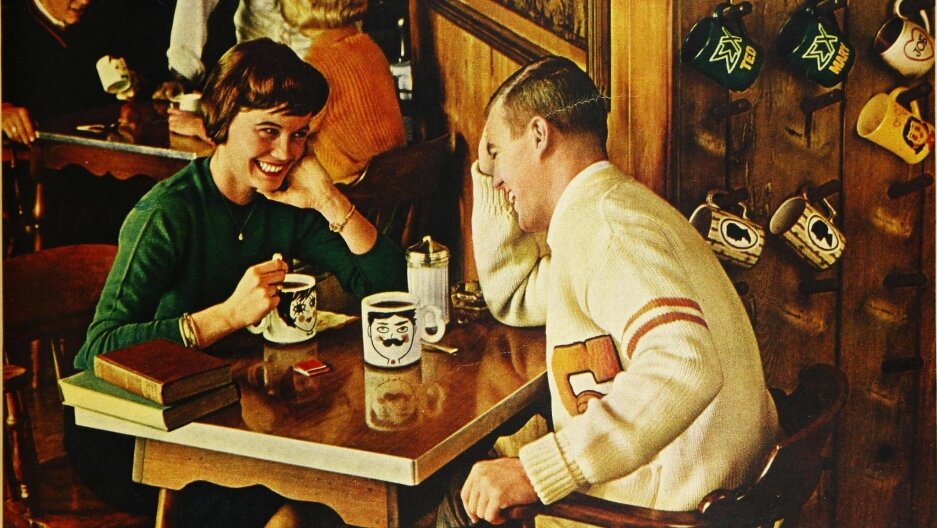
And in the music realm, how about this great song performed by Eddie Hodges, the child star best known as Huck Finn in the 1960 adaptation directed by Michael Curtiz? "Mugmates" suggests that what "everyone does" now to indicate they are going steady, instead of giving someone their pin, is simply have... matching coffee mugs.

Eddie Hodges

Eddie Hodges - Mugmates [mp3]

Audio clip: Adobe Flash Player (version 9 or above) is required to play this audio clip. Download the latest version here. You also need to have JavaScript enabled in your browser.

Remember that “Gift” means “poison” auf Deutsch

November 18th, 2009

Oh man. My friends continue to be involved in plays that offer critics the opportunity to write the best reviews ever. Here's Chris Jones's review in the Trib of a production two of my friends are in, G.I.F.T. at Collaboraction (which, admittedly, does put on some fine work also):

Collaboraction and the G.I.F.T. that keeps on taking

There is much computer-aided mumbling about present-giving in "G.I.F.T.," Collaboraction's typically ambitious seasonal offering performed, both indoors and outdoors, in a 7,000-square-foot warehouse space at Firehouse Square on Chicago's West Side. But the greatest gift of all arrives when a big overhead door whirs and opens, revealing that this insufferable show is over.

Actually, not quite over. "G.I.F.T." ends around a big outdoor bonfire. But some communing around flames is, compared with what has gone before, positively cathartic.

Collaboraction, which long has favored experimental performances in a variety of urban spaces, always has had a high failure rate. So it goes when you try to do something different. But "G.I.F.T." is surely the worst thing the theater has produced in its 13 years of existence. This piece is so grim, you keep waiting for the actors (who are dressed as slightly funky Pilgrims) to step out of their stark, computer-aided environment (they work in front of projected text) and declare the whole enterprise an elaborate, "Waiting for Guffman"-style parody of bad performance art. Sadly, that moment never arrives.

In essence, this piece (designed and directed by Sam Porretta) is a study of the nature of gifts. It begins in a little interactive chamber, where patrons and performers exchange objects of unfathomable definition and viewers are asked to visit little grottoes, wherein meek performers (apparently) try to discern your emotions and reveal your stories. Yes, you pay them for this stuff. They don't pay you.

From there, you head to the main performance space, where these actors engage in a deadly dull series of exercises about what gifting means. It is as if one has happened upon freshmen at a theater school improvising on a teacher's truisms. We arrive at such staggering conclusions as gifting means more than materialism.

Yes, the holidays are more than a new blender. Now you don't have to waste an evening.

There is, I suppose, a certain trippy quality to the proceedings. And the building (an old firehouse) is a beautiful, atmospheric space. Thankfully, there is a bar. If you find yourself dragged to this show, I suggest plunking yourself there until you hear the lick of the flames of freedom.

My life is right.

November 12th, 2009

Margo Guryan became a fan of The Heavy Boxes.

This Thing Sounds Like That Thing #3

November 4th, 2009

Brian Eno - Here Come the Warm Jets [mp3]

Audio clip: Adobe Flash Player (version 9 or above) is required to play this audio clip. Download the latest version here. You also need to have JavaScript enabled in your browser.

Brian Eno

Beulah - Emma Blowgun's Last Stand [mp3] (at 2:25)

Audio clip: Adobe Flash Player (version 9 or above) is required to play this audio clip. Download the latest version here. You also need to have JavaScript enabled in your browser.

Beulah

The City That Works

November 2nd, 2009

More than a month ago, the city of Chicago tore up every street around my house so they could resurface them. On day one, they screwed up and broke the water main under my block. Though they've since repaved most of the other blocks around my house, the cryptic letter they left us said that ours won't be finished until "sometime in 2010."

In the meantime, we're left with this sign that fails to use either of the two acceptable spellings of "thru."

No Threw Traffic

Le Ballon argent

October 16th, 2009

As one of many people closely following the story of Falcon Heene yesterday with rapt attention, I have to strongly object to the unfortunate nickname the media and others are bestowing on him: "Balloon Boy." This name reflects the general attitude I've noticed where people regard the incident merely as wacky news. "OMG, it's a real-life version of Up!" seems to be the common sentiment, turning Falcon into fodder for late-night comedians' monologues.

The Fall of Icarus (Jacob Peter Gowy)

Was I the only person not to see goofiness in the story, but instead saw it as mysterious and beautiful as it unfolded? To me, this wasn't just a stunning example of bad parenting, but represented supreme wish-fulfillment. A six-year-old boy untethering the mysterious flying machine behind the house, embarking on a tremendous adventure, escaping from a drab family life into the air. It was as if an ocean had tumbled by with a private airship for Falcon.

While watching the live feed of the balloon rapidly descending, I was filled with concern for his safety, but my concern really more closely resembled the feeling of exhilaration I get in a falling dream moments before waking up. And when the realization came that he was not in the balloon and could be seemingly anywhere in a large area of rural Colorado, my imagination continued to run wild. After it was suggested he might be hiding in the neighborhood for fear of retribution, the efforts of officials on the ground to find him no longer seemed like a "search,", but instead became a "chase" in my mind. Falcon was a fugitive from a world threatened by his imagination and his desire to fly away to something better.

The whole incident invites obvious comparisons to so many cultural touchstones, but I'm shocked by how everyone is comparing it to the wrong ones. This isn't about Up or Danny Deckchair! Have people forgotten Le Ballon rouge? Brewster McCloud? And, most importantly, the story of Daedelus and Icarus, of the tragic consequences of a father's attempt to give his son flight?

By this time Icarus began to feel the joy
Of beating wings in air and steered his course
Beyond his father’s lead: all the wide sky
Was there to tempt him as he steered toward heaven.
Meanwhile the heat of sun struck at his back
And where his wings were joined, sweet-smelling fluid
Ran hot that once was wax. His naked arms
Whirled into wind; his lips, still calling out
His father’s name, were gulfed in the dark sea.
And the unlucky man, no longer father,
Cried, “Icarus, where are you, Icarus,
Where are you hiding, Icarus, from me?”
Then as he called again, his eyes discovered
The boy’s torn wings washed on the climbing waves.
He damned his art, his wretched cleverness,
Rescued the body and placed it in a tomb,
And where it lies the land’s called Icarus.

And that's why I'm not bothered by the possibility that it all may have been a hoax. From the beginning, the story always lay more in the realm of myth. The fact that the boy flying away was named Falcon makes it clear. This was never a news event. It was a fable.

A polite request

October 13th, 2009

Dear Student Filmmakers:

My favorite “Dark Shadows” quote so far

October 13th, 2009

Dark Shadows

Since November of 2006, I have been slowly plodding through Dark Shadows, the classic vampire soap opera from the '60s. I've watched some 270 episodes now, but considering there are a total of 1,225 episodes to see, at my current pace, I won't be finished with the show until some time in 2019.

But in all the hundred hours of the show I've seen so far, my favorite line came in the episode I saw last night:

"I was under the impression that you wanted to discuss my harpoon collection."

Also, the framed reproduction of the portrait of Barnabas Collins hanging in my living room often yields amusing results while watching the show:

Barnabas Collins & Barnabas Collins

Thursdays at Doc Films: The Public Life of Charles Laughton

October 1st, 2009

Charles Laughton & Robert Mitchum

In addition to the Downtown 81 series, I am also presenting a retrospective at Doc Films of the work of Charles Laughton, one of my favorite actors, Thursday evenings at 7 p.m. Laughton is one of a handful of actors I can think of that I've noticed instantly make films more enjoyable, regardless of the movie's quality or the size of their role, simply by their presence. This series has nine of his best performances, including some relative rarities, and I very much hope you come see them. It begins tonight with Les Misérables.

Doc Films is located in Ida Noyes Hall at 1212 E. 59th St. in Chicago. Tickets are just $5, or you can get a pass for all 80-or-so films in the quarter for only $30.

The quick schedule of the series, my essay about it, and descriptions of each film:

Oct. 1 - Les Misérables
Oct. 8 - Island of Lost Souls
Oct. 15 - White Woman
Oct. 22 - The Private Life of Henry VIII
Oct. 29 - The Suspect
Nov. 5 - The Sign of the Cross
Nov. 12 - Witness for the Prosecution
Nov. 19 - Advise & Consent
Dec. 3 - The Night of the Hunter


The Public Life of Charles Laughton

Hollywood's blusteriest star.

There has never been a Hollywood star comparable to Charles Laughton. With his portly shape and blustery persona, he could easily have remained in the company of Edward Everett Horton, Thomas Mitchell, and Andy Devine as a successful character actor forever serving as sideman to the handsome stars of the moment. Instead he somehow became one of the most unlikely and distinctive leading men in the industry. Laughton delivered fiercely energetic performances in iconic role after iconic role, projecting intelligence and genuine pathos no matter how much scenery he managed to chew in the process.

At his best, Laughton committed himself to his acting to a degree few other performers can claim. He was a proto-Method actor – or perhaps more accurately, “a Method actor without the bullshit,” as James Mason described him - often changing his physical appearance for a role as much as his body would allow. George Cukor called him “the first actor I encountered who prepared to make a laughing entrance by going around doing ha-ha! sounds for hours.” But despite any resemblance of his technique to Stanislavsky’s System, it was in fact his friend Bertolt Brecht who championed Laughton as a natural embodiment of his theories. In Brecht’s view, Laughton’s method was only a partial immersion: “The actor appears on stage in a double role, as Laughton and as Galileo; the showman Laughton does not disappear in the Galileo he is showing; Laughton is actually there, standing on the stage and showing us what he imagines Galileo to have been.”

Indeed Laughton brought something very personal to his finest roles. Despite routinely playing emperors, kings, and other Great Men, Laughton managed to channel his own personal struggles and put them on display to the public. He suffered from a crippling lack of self-confidence; he hated his appearance (“I have the face like he behind of an elephant,” he would say); and he struggled with his homosexuality throughout his life-long marriage to fellow actor Elsa Lanchester. The troubled, obsessed characters like Javert in Les Misérables were never far from Charles Laughton the man.

He was a remarkably versatile actor, equally at home in lavish historical drama like The Private Life of Henry VIII, gentle comedy like Ruggles of Red Gap, and stylish film noir like The Suspect. Notoriously difficult to work with, and self-conscious about that fact, Laughton still collaborated with many of cinema’s great directors, including Jean Renoir, Billy Wilder in Witness for the Prosecution, Alfred Hitchcock, Otto Preminger in Advise & Consent), Leo McCarey, and David Lean. Even Ozu seemed to have recognized his brilliance early on, as he included a clip of Laughton’s performance from the Lubitsch-directed segment of If I Had a Million to great effect in Woman of Tokyo.

Although he worked with so many masters, some of Laughton’s greatest performances came in fact from his less distinguished films. The camp of movies like Island of Lost Souls and White Woman perhaps does not represent the artistic zenith of Laughton’s career, but it demonstrates an essential quality of his brilliance. He worked best when he had the liberty to completely invent his own character from nothing, whether creating White Woman’s absurd jungle plantation owner or transforming Nero into a flamboyant queen in The Sign of the Cross. The subpar source material worked to his benefit, essentially offering him a blank canvas to paint on. Conversely, Laughton struggled throughout his career with performing standard Shakespeare and Dickens roles on stage. He was, it seems, less an interpreter of roles than a fervent inventor of personalities.

Island of Lost Souls

It’s this passion that Laughton brought to his characters that makes him an easy target for accusations of overacting. To be sure, Charles Laughton was a ham, but in the best sense of the word. Rather than overact in his movies, he managed instead to transcend the film somehow. His performance becomes something more tangible than the film itself. Even in the most unmemorable movie, Laughton’s character lingers long in the audience’s memory. One at times feels sorry for his co-stars, for even if their acting is pitch-perfect, Laughton simply dominates the screen even in a minor role.

Despite a litany of iconic performances over a prolific career, it’s still hard not to dwell on what Laughton might have accomplished. Due in part to the anxieties of both Laughton and the director Joseph von Sternberg, an adaptation of I, Claudius was infamously never completed. The film, which exists now only in about twenty-five minutes of dailies, has since become the stuff of legend. From viewing only these surviving fragments, critic Jonathan Rosenbaum declared it “arguably the greatest piece of acting in all of sound cinema: better than Brando, better than Olivier, better even than Chaplin in Monsieur Verdoux.” Our retrospective concludes with The Night of the Hunter, Laughton’s lone entry in a directing career that never was. The stunning visual style; the overwhelming feeling of suspense; the breathtaking performances Laughton coaxed out of Robert Mitchum, Shelley Winters, and Lillian Gish – it all adds up to one of the great masterpieces of American cinema, and an astonishingly confident debut from a man who was anything but.

The Sign of the Cross

The Films

Thursday, October 1 at 7:00 • 105m
Les Misérables
Richard Boleslawski, 1935 • In the first sound adaptation of Victor Hugo's novel in English, Fredric March stars as convicted bread thief Jean Valjean. March is a perfect match for Laughton's wonderful performance as the obsessed Inspector Javert, unrelentingly pursuing Valjean over a period of decades. Between this, Mutiny on the Bounty, and Ruggles of Red Gap, 1935 marked an extraordinary year for Laughton. His over-the-top bluster here feels delightful and appropriate, unlike the over-the-top bluster of the dreadful 1980 musical adaptation that helped destroy Broadway forever—Susan Boyle be damned. 35mm

Thursday, October 8th at 7:00 • 67m
Island of Lost Souls
Erle Kenton, 1932 • Charles Laughton was perhaps born to play a mad scientist, and he makes the most of the opportunity in this creepy version of H.G. Wells's Island of Dr. Moreau. Richard Arlen and Leila Hymans are shipwrecked on Moreau's island, where the doctor has been conducting experiments combining humans and animals. His bizarre creations, led by none other than Bela Legosi, are barely under control. Laughton's performance, which he apparently based on his dentist, marked his first starring role in an American film. Find here the source for Devo's famous chant of "Are we not men?" from their 1977 song "Jocko Homo." 35mm, not available on DVD

Thursday, October 15th at 7:00 • 68m
White Woman
Stuart Walker, 1933 • A bizarre pre-code gem about a despotic rubber plantation owner in Malaysia married to a nightclub singer (Carole Lombard). Terrorized by her husband (Laughton), she begins a relationship with one of his employees. Though he did not think fondly of the film and disliked working with Lombard, who he said was not a "controlled actress," Laughton's overblown performance among the headhunters and spear fights of the jungle makes the film a real joy. During filming, Laughton insisted that Ravel's Bolero be played in between takes to sustain the tense jungle atmosphere. Archival 35mm, not available on DVD

Thursday, October 22nd at 7:00 • 97m
The Private Life of Henry VIII
Alexander Korda, 1933 • Never is Laughton given license to let loose and chew scenery more than in this star-making turn as the titular monarch. Henry blusters his way through five marriages, contending with wives and lovers played by likes of Merle Oberon, Binnie Barnes, Robert Donat, and Laughton's real-life wife Elsa Lanchester. Tremendous fun and gleefully inaccurate, the film's worldwide success became a major breakthrough not only for Laughton, but for British cinema as a whole. Laughton would again collaborate with Alexander Korda on the equally excellent historical biopic Rembrandt. 16mm

Thursday, October 29th at 7:00 • 85m
The Suspect
Robert Siodmak, 1944 • One of director Robert Siodmak's best works, this film noir, set in 1902 London, stars Laughton as a bank teller with a horrid wife (Rosalind Ivan). He begins an innocent friendship with the young and beautiful Mary Gray (Ella Raines), but his wife learns of it and is consumed with rage. Laughton then kills his wife and covers it up as an accident, but of course, he still raises the suspicions of a Scotland Yard inspector, as well as his neighbor. The result is a classic suspense tale, taut and finely crafted, largely thanks to the excellent performance of Laughton. 35mm, not available on DVD

Thursday, November 5th at 7:00 • 125m
The Sign of the Cross
Cecil B. DeMille, 1932 • In making this Roman epic, his comeback project at Paramount, DeMille met with tremendous resistance by the studio, forcing him to recreate ancient Rome on a modest budget. Perhaps distracted by these struggles, DeMille allowed Laughton to transform his interpretation of Emperor Nero into a raging queen, complete with a nude, nubile young man sitting by his side. The film became a hit, yet for decades faced censorship battles, including over an infamous scene where Claudette Colbert bathes in milk. This archival print, restored from DeMille's personal copy, returns the film to its uncut form. Archival 35mm

Thursday, November 12th at 7:00 • 114m
Witness for the Prosecution
Billy Wilder, 1957 • Billy Wilder adapts this thrilling mystery by Agatha Christie to great effect. Laughton plays Sir Wilfred Robards, a successful British attorney defending Leonard Vole (Tyrone Power) against a murder charge, despite his poor health. Sir Robards is shocked to discover that Vole's wife, played by Marlene Dietrich, plans on appearing as a witness for the prosecution. Elsa Lanchester also appears, and both husband and wife would eventually be rewarded with Oscar nominations. The twisting plot and witty dialog show both Christie and Wilder at the top of their form.35mm

Thursday, November 19th at 7:00 • 140m
Advise & Consent
Otto Preminger, 1962 • While battling bone cancer, Charles Laughton made his final screen appearance in Otto Preminger's slow-burning adaptation of Drury's Pulitzer Prize-winning political novel. Henry Fonda plays Robert Leffingwell, a liberal appointed by the President to serve as Secretary of State, sparking an intense confirmation battle that puts the careers of several politicians in jeopardy. Players in the drama include Burgess Meredith, Walter Pidgeon, and Laughton donning a southern drawl as a fiery senator from South Carolina. Preminger reportedly also offered a role to Martin Luther King, Jr., who declined. Archival 35mm
Preserved by the Academy Film Archive with funding from the Andrew J. Kuehn Jr. Foundation.

Thursday, December 3rd at 7:00 • 90m
The Night of the Hunter
Charles Laughton, 1955 • It's difficult to encapsulate the power of The Night of the Hunter, the greatest directorial debut this side of Citizen Kane, which, sadly, would also be Laughton's only directorial credit. Robert Mitchum gives one of film's most iconic performances as a sinful preacher who marries a fragile widow so that he can torture her two children into revealing the location of a hidden fortune. Pulitzer Prize-winner James Agee wrote the screenplay, with Laughton himself providing an uncredited rewrite. A terrifying slice of Americana filled with haunting imagery, this is, simply put, as good as cinema gets. Archival 35mm

Tuesdays at Doc Films: Downtown 81

September 29th, 2009

The Fall 2009 calendar at Doc Films begins this week, and there are two series on it that I programmed. The first one, which I put together with my good friend Hannah, is called Downtown 81 and focuses on the work of the downtown New York artists of the '70s and '80s. The series runs every Tuesday night at 7 p.m., beginning tonight with James Nares's Rome 78. We're really excited for this series and have been talking about doing it for a long time. Basically, it's just an excuse for us to showcase some of our mutual favorite movies and artists, like Laurie Anderson, John Lurie, Spalding Gray, and Talking Heads.

Doc Films is located in Ida Noyes Hall at 1212 E. 59th St. in Chicago. Tickets are a measly $5, or you can get a pass for all 80-or-so films in the quarter for only $30.

Here's the quick list of the films in series, then the essay about it that Hannah and I wrote, and finally the descriptions of each film:

Sep. 29 - Rome 78
Oct. 6 - The Vasulkas: Selected Works I & II
Oct. 13 - Stranger Than Paradise
Oct. 20 - Home of the Brave
Oct. 27 - The Kitchen Presents Two Moon July
Nov. 3 - Downtown 81
Nov. 10 - True Stories
Nov. 17 - Swimming to Cambodia
Nov. 24 - Stop Making Sense
Dec. 1 - Ellis Island & Book of Days

Swimming to Cambodia

Downtown 81

The New York arts scene of the '70s and '80s

Since at least the 1960s, downtown Manhattan was the home to a diverse community of artists committed to experimentation within their art and lifestyle. The blurring of art and life and the dissolution of the barriers between artistic disciplines can be seen in the work of downtown residents of the early ‘60s, such as Jack Smith and Tony Conrad. Coming generations of artists in the Lower East Side would sustain this radical ethos, and they are the focus of our series, Downtown 81.

This series focuses on films from the mid-1970s and ‘80s, and highlights the diversity of voices and flexibility characteristic of the downtown arts scene of the time. Many of the artists showcased were associated with the Kitchen, a venue started in the early '70s by Steina and Woody Vasulka with the intention of exhibiting video and performance art.

The Vasulkas’ Selected Works I & II illustrates their creative output during the early years of the Kitchen. Due to its willingness to embrace a broader definition of what was considered art, the Kitchen became home to numerous experimental bands and mixed media projects, many of which can be seen in the concert film The Kitchen Presents Two Moon July.

Downtown artists also made significant innovations in experimental theatre. The Mabou Mines company performed radical interpretations of classic texts in non-traditional theatre spaces, while the Wooster Group created performances from found material, recycled texts, and their own autobiographies. Spalding Gray produced a series of autobiographical monologues with the Wooster Group, most notably Swimming to Cambodia, which was released as a film under the direction of Jonathan Demme. Both companies were inspired by the work of Meredith Monk, director of Ellis Island and Book of Days, whose epic theatrical events blended dance, music, film, and opera.

The No Wave movement, another crucial voice in the downtown arts scene, is a product of the creative influence of punk rock on the art community. Rhys Chatam, Arto Lindsay, and other artists were decisively inspired by bands such as the Ramones, who were getting their start at Lower East Side venue CBGB. This intercommunication seen in No Wave produced the distinct aesthetic displayed in work by Lydia Lunch, James Chance, and No Wave filmmakers such as Amos Poe and James Nares. Nares's Rome '78 features an array of crucial contributors to the scene and displays a punk approach to filmmaking.

Stranger Than Paradise

Edo Bertoglio’s Downtown 81 uses a similar format to that of Rome 78, following Jean-Michel Basquiat as he encounters artists and musicians on the Lower East Side. These films give a sense of the thriving community, and of the participatory ethic that was definitive of the scene. The opposition to professionalism characteristic of the punk attitude set the mood for a scene in which artists were inspired to try their hand at making music, acting, or directing without regard to the boundaries of discipline, both initiating diverse projects of their own or participating in those of their friends. All three stars of Jim Jarmusch’s film Stranger than Paradise started as musicians; leading man John Lurie also composed the film’s original score. In fact, Jarmusch himself was at one time a member of the No Wave band the Del-Byzanteens. The frequency with which artists appear as contributors to the films in this series demonstrates how essential this collaborative spirit was to the productivity of the scene.

In covering a relatively wide time range, the series tracks the full trajectory of celebrity for several artists featured in these films. David Byrne, who was involved in the Kitchen, was at the height of fame by the mid-‘80s with the Talking Heads. Before the release of Stop Making Sense and True Stories, they had scored a top ten hit in the U.S. with the song “Burning Down the House.” Likewise, Laurie Anderson, who also performed at the Kitchen, was two albums into a record deal with Warner Brothers when she made her concert film, Home of the Brave. These concert films are not from the downtown arts scene proper, but instead offer insight into the way these artists continued to apply the sensibility gained during their involvement in the scene toward their work.

The inclusion of these later works also highlights how remarkable it is that so many artists from the scene were able to achieve mainstream popularity. Byrne, Anderson, Philip Glass, Cindy Sherman, and Bill T. Jones have all become international celebrities – all working within a neighborhood with a total area under a square mile. This mainstream success also signaled the end of the movement. The rising cost of living meant that within the next decade, lower Manhattan would no longer be conducive to the kind of movement that had thrived there since the '60s. While the movement ended, the participatory approach to art influenced the generations that followed, and has been applied in communities worldwide. It is our hope that this series offers a chance to think critically about the collaborative ethic that defined the period.

Stop Making Sense

The Films

Tuesday, September 29th at 7:00 • 82m
Rome 78
James Nares, 1978 • Painter, performance artist, and former Contortions bandmember James Nares directed this classic of No Wave cinema. An irreverent and playful period drama, the film is as much a documentary of late-70s Lower East Side as it is a fiction film about the late Roman Empire. David McDermott III stars as Caligula, Anya Phillips plays the Queen of Sheba, and Lydia Lunch, lead singer of Teenage Jesus and the Jerks and star of many films produced in the movement, also appears. Critic J. Hoberman, an early champion of No Wave, described the film as "like a toga party in Little Lulu's clubhouse." 16mm, not available on DVD

Tuesday, October 6th at 7:00 • 52m
The Vasulkas: Selected Works I & II
Steina and Woody Vasulka, 1974 • The Vasulkas were pioneers of the video art form, and founders of The Kitchen. They were among the first to have their video works included in the Whitney Biennial, and have remained innovators of the genre, both technically and formally. These selected works serve as a sampling of the Vasulkas's work during the early years of the Kitchen, a time in which they were primarily concerned with the production of synthetic video images. Through their emphasis on the materiality of video with the use of static and wave patterns, the Vasulkas forge images of a natural beauty akin to landscapes. DVD, not commercially available on DVD

Tuesday, October 13th at 7:00 • 95m
Stranger Than Paradise
Jim Jarmusch, 1984 • Eva, freshly arrived from Hungary, walks the derelict streets of New York in search of her cousin Willie. She pauses to turn on her portable tape player, and continues to the sound of Screamin' Jay Hawkins, hysterically repeating "I Put a Spell On You." With this scene, Jarmusch established himself as an innovator of American cool and informed the idiom of independent American cinema with a blend of style and incongruent humor. As Willie's sidekick (Richard Edson, one-time drummer for Sonic Youth) tags along on a trip across the U.S., Jarmusch weaves nuanced relationships between off-beat characters. 35mm

Tuesday, October 20th at 7:00 • 90m
Home of the Brave
Laurie Anderson, 1986 • Five years after landing a surprise pop hit with "O Superman," performance artist (and Glen Ellyn, Illinois native) Laurie Anderson directed her own concert film while touring in support of her album "Mister Heartbreak." Playing violin and synthesizer along with a full band, she layers poetry on top of electronic music in this innovative multimedia performance, and her deadpan observations are at once hilarious and spooky. William S. Burroughs, the inspiration for her song "Language is a Virus," also appears on stage at one point to dance a tango with Anderson. Laserdisc, not available on DVD

Tuesday, October 27th at 7:00 • 53m
The Kitchen Presents Two Moon July
Tom Bowes, 1985 • Founded in the early '70s by Steina and Woody Vasulka, The Kitchen became one of the most important art spaces of the downtown scene. Located in the kitchen of the Mercer Arts center, it started as a space for video art, but eventually expanded to include artists across several disciplines, as illustrated in this film. Originally filmed as a television project, Two Moon July is a unique document of this community, bringing together many of its talented artists, including David Byrne, Bill T. Jones, Laurie Anderson, Cindy Sherman, John and Evan Lurie, Philip Glass, Brian Eno, Robert Longo, and Bill Viola. DVD, not available on DVD

Tuesday, November 3rd at 7:00 • 71m
Downtown 81
Edo Bertoglio, 1981 • Also known as New York Beat Movie, Downtown 81 is a fascinating portrait of the New York scene in the early '80s. The then-unknown Jean-Michel Basquiat stars as a character much like himself, who spends the day wandering the Lower East Side, encountering many notable figures from the scene, including Debbie Harry, the Plastics, and John Lurie. Glenn O'Brien, host of the infamous public access show TV Party, wrote the screenplay. Financing issues caused the film to be abandoned until 2001. As much of the original soundtrack was lost, Basquiat's dialog was re-recorded by actor and poet Saul Williams. 35mm, not available on DVD

Tuesday, November 10th at 7:00 • 90m
True Stories
David Byrne, 1986 • Featuring a score by Talking Heads, True Stories is a beautiful, bizarre take on small town life. Byrne, sporting a ten-gallon cowboy hat, guides us through the fictional town of Virgil, Texas, as its citizens prepare for the "Celebration of Special-ness." Inspired by headlines from tabloids, the film wanders from character to character, such as the woman who never leaves her bed, the man with a radio in his head (the inspiration for the British band's name), and the engineer with the consistent panda bear shape looking for love. The result is an intruiging variation on the traditional American musical. 35mm

Tuesday, November 17th at 7:00 • 85m
Swimming to Cambodia
Jonathan Demme, 1987 • In the first of his filmed monologues, Spalding Gray recounts his experiences in Southeast Asia filming his supporting role in The Killing Fields. Armed only with a glass of water, a writing pad, and a map, he provides a compelling example of storytelling at its finest. Gray, a co-founder of the experimental theatre company the Wooster Group, pioneered in this film a form of autobiographical one-man-show whose influence is still seen today. Demme's minimalistic direction gives room to focus on Gray's hilarious and touching anecdotes, while Laurie Anderson provides an appropriately haunting score. 35mm, not available on DVD

Tuesday, November 24th at 7:00 • 88m
Stop Making Sense
Jonathan Demme, 1984 • Beginning with David Byrne performing "Psycho Killer" alone with a drum machine and growing to an enormous band with backup dancers, this classic concert film catches Talking Heads at the height of their global success. By this point, Byrne had developed into one of music's great showmen, and moments from his performance—dancing with a lampshade, jogging in a circle around the stage, and donning his famous big suit—have since become iconic. Demme's fluid direction helps make this, along with >i/i<, one of the greatest rock n' roll films ever made. Thanks! Does anybody have any questions? 35mm

Tuesday, December 1st at 7:00 • 100m
Ellis Island & Book of Days
Meredith Monk, 1981 & 1988 • Monk, a filmmaker, choreographer, and composer, filmed Ellis Island at the famous port of entry before its 1990 restoration. Described by Monk as a "ghost story told through the musicality of images," it blends fiction, documentary, and dance to explore the story of the millions of immigrants who passed through. In the dreamlike Book of Days, Monk juxtaposes black and white depictions of the tumult of the Middle Ages with color scenes of a contemporary AIDS-plagued world. Music, dance, and stunning cinematography mix into a haunting and often humorous meditation on the transparency of time. 35mm, not available on DVD

  • Upcoming Events